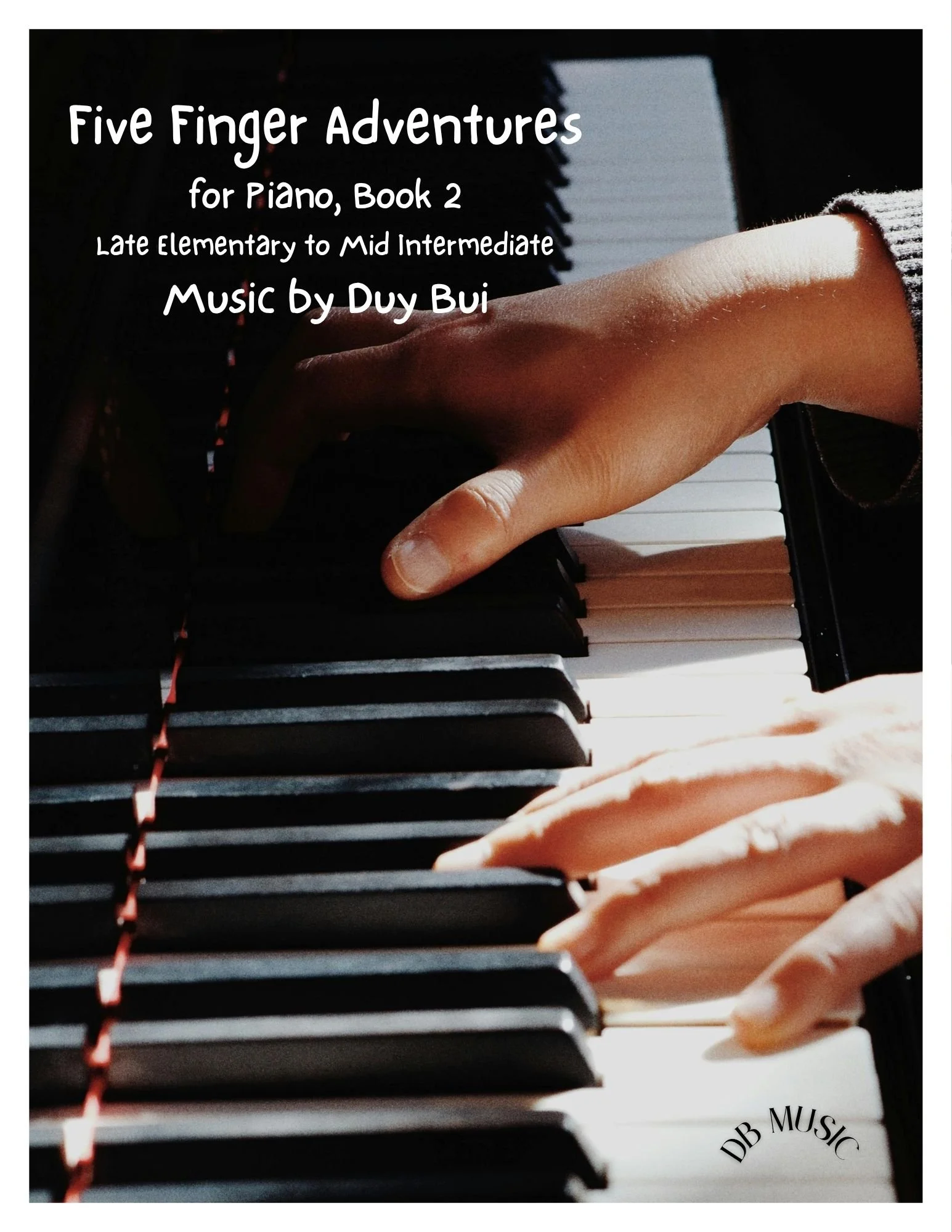
The first in this series, Five Finger Adventures, Book 1, written for late-elementary to early-intermediate pianists. As with most of my compositions, these pieces grew out of my work in piano lessons with my students.
I have found that many beginner students progress quickly but eventually encounter difficulties when they reach the late-elementary and intermediate levels. Both my observations and conversations with students suggest that music at the intermediate level often becomes challenging because technical training is inadequate. We spend much of the lesson time reading notes and learning the musical elements within the repertoire being studied, leaving very little time to focus on technique. We certainly do not have time for creative exploration, such as improvisation.
Since I also teach in a public middle school, I have realized that our students’ lives are much busier than when I was a child. Reflecting on my conversations with students and the challenges they face, I began thinking about how I might better support them.
I recalled that in band music, during the first year or so, the repertoire rarely exceeds five or six notes, yet it is still able to engage and maintain the attention of middle school students—which, as any middle school teacher will tell you, can be challenging at times. One reason composers are able to create engaging music with only five or six notes (in addition to their creativity and skill) is because the instruments themselves are designed and tuned to provide adequate range and beautiful tonal colors.
Although the piano does not offer the same timbral variety as a middle school band, it does allow us to play ten or more notes simultaneously. With this in mind, I began writing five-finger exercises, and from there, these pieces were created.
These short pieces, written in different but fixed five-finger positions, were composed for late-elementary to intermediate pianists to encourage technical and musical development. They include challenging rhythms, divided or flowing melodic lines, both consonant and dissonant harmonies, and creative use of dynamics. The pieces also introduce students to a variety of musical genres and styles. The enduring goal of each piece is creativity.
Below, you can see and hear samples of the music from Five Finger Adventures Book 1.
The first in this series, Five Finger Adventures, Book 1, written for late-elementary to early-intermediate pianists. As with most of my compositions, these pieces grew out of my work in piano lessons with my students.
I have found that many beginner students progress quickly but eventually encounter difficulties when they reach the late-elementary and intermediate levels. Both my observations and conversations with students suggest that music at the intermediate level often becomes challenging because technical training is inadequate. We spend much of the lesson time reading notes and learning the musical elements within the repertoire being studied, leaving very little time to focus on technique. We certainly do not have time for creative exploration, such as improvisation.
Since I also teach in a public middle school, I have realized that our students’ lives are much busier than when I was a child. Reflecting on my conversations with students and the challenges they face, I began thinking about how I might better support them.
I recalled that in band music, during the first year or so, the repertoire rarely exceeds five or six notes, yet it is still able to engage and maintain the attention of middle school students—which, as any middle school teacher will tell you, can be challenging at times. One reason composers are able to create engaging music with only five or six notes (in addition to their creativity and skill) is because the instruments themselves are designed and tuned to provide adequate range and beautiful tonal colors.
Although the piano does not offer the same timbral variety as a middle school band, it does allow us to play ten or more notes simultaneously. With this in mind, I began writing five-finger exercises, and from there, these pieces were created.
These short pieces, written in different but fixed five-finger positions, were composed for late-elementary to intermediate pianists to encourage technical and musical development. They include challenging rhythms, divided or flowing melodic lines, both consonant and dissonant harmonies, and creative use of dynamics. The pieces also introduce students to a variety of musical genres and styles. The enduring goal of each piece is creativity.
Below, you can see and hear samples of the music from Five Finger Adventures Book 1.

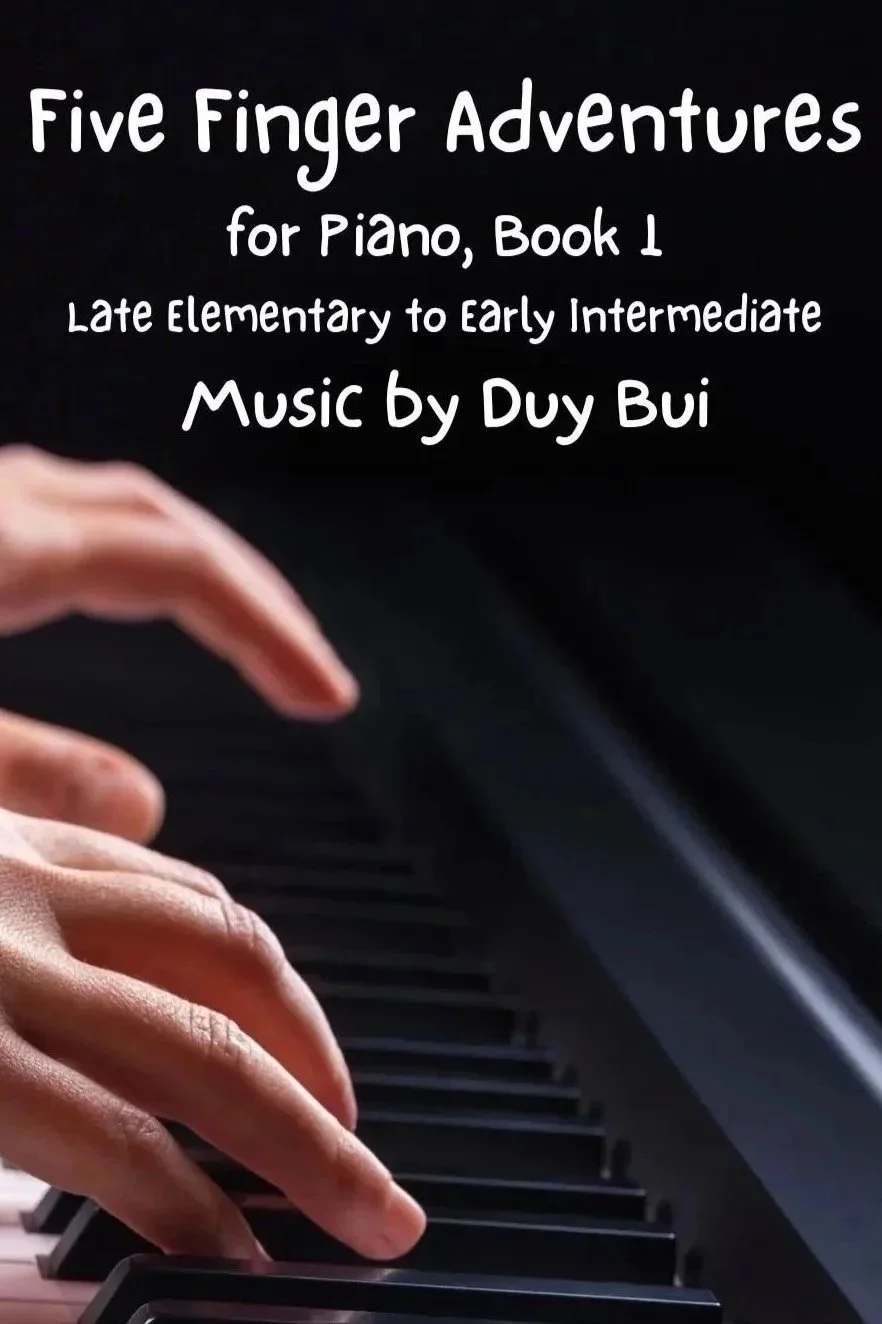 Image 1 of 1